| Pro-Light-News™ | Architectural Lighting |
| Main Pro-Light-News | Index Architectural Lighting | Search Site | PRO-MUSIC-NEWS |
Martin Professional Extube with RGB+White colour mixing
The Extube Series from Martin Professional is a modular system of IP65 rated linear LED luminaires designed for dynamic illumination of outdoor architecture and much more. With RGB+W colour mixing, a choice of opaque lenses and easy installation, Extube is ideal for a variety of dynamic illumination needs including floodlighting, wall-grazing, cove lighting or creating continuous lines of decorative colour, inside or out. Extube was introduced at PLASA 2008 and at LDI, Las Vegas.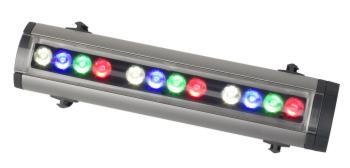 Extube is available in two lengths; 30 cm (1 ft, 12 LEDs) and 120 cm (4 ft, 48 LEDs). A simple all-in-one dynamic lighting solution, Extube is weatherproof rated at IP65 for the outdoor illumination of facades, structures, bridges, cruise ships and more. Made of robust extruded aluminum, the Extube’s slim aesthetics allows the luminaire to blend inconspicuously into existing architecture. It is also an ideal decorative lighting effect for clubs and lounges and will fit perfectly into TV, theatre and touring shows. Extube is available in two lengths; 30 cm (1 ft, 12 LEDs) and 120 cm (4 ft, 48 LEDs). A simple all-in-one dynamic lighting solution, Extube is weatherproof rated at IP65 for the outdoor illumination of facades, structures, bridges, cruise ships and more. Made of robust extruded aluminum, the Extube’s slim aesthetics allows the luminaire to blend inconspicuously into existing architecture. It is also an ideal decorative lighting effect for clubs and lounges and will fit perfectly into TV, theatre and touring shows.Extube is a high output luminaire with a lamp life rating of 20,000 hours and no movable parts, service intervals are few and far between. The Extube comes with a choice of narrow, medium and wide diffuser options, or it can be used without a diffuser for an even narrower beam. The standard spread angle is narrow for long throws and the module is tiltable for precise optical aiming. If ambient temperatures are too high, output from the LEDs is automatically decreased. This extends the lifespan of the diodes, and ensures that output is maintained at the optimum level. A central feature of the Extube is its ability to create even and consistent colours. Each pixel board has been measured and calibrated, guaranteeing standardized brightness and color performance. The Extube’s RGB+W diodes excel at creating deep, saturated colors and the addition of the white LED gives several advantages: a true white, the ability to adjust colour temperature, and the possibility to create soft pastel shades. The Extube offers greater intuitive control of colour, with four distinct control modes. In addition to RGB (three channel) and RGBW (four channel) color fine-tuning, HSI (Hue, Saturation, Intensity) lets you set the effect you want by scrolling through hues, altering their saturation and changing their intensity. HSI-C adds colour temperature control to the intuitive benefits of HSI. The Extube is controlled by industry standard DMX 512-A. For greater flexibility, the long version can be controlled either as 4 single pixels or as one pixel. The Extube is 0-100% dimmable for balance of brightness or the ability to respond intelligently to the availability of natural light. Installation of the Extube is as easy as it gets. The simple click-together system slides onto standard DIN rail. There is no need for an external power supply or control box unit; everything is built into the Extube, reducing logistical costs and hassle. Extube automatically auto-addresses during set-up. The Extube is built up around modular, interconnectable units. The simple click-together system has cable-less loop-through of data and power, which limits set-up time, reduces cable mess and ensures a clean look. The luminaire is convection cooled so no fans or other moving parts are used, and the Extube comes with a switch mode power supply for worldwide compatibility. Rigorously tested and CE, ETL and CETL approved, the Extube is built for simplicity. |
 |